

Research News
Shanghai Astronomical Observatory Researchers Uncover the Evolutionary Mechanisms of Giant Planet Pairs: Who Gets More Gas in a Common Gap?
Multi-giant-planet systems are not rare in the Universe, and giant planet pairs like Jupiter and Saturn are frequently found in exoplanetary systems. Yet exoplanet observations reveal a puzzling trend: many compact giant planet pairs have comparable masses, and in some systems the outer planet is even more massive than its inner companion. Were these mass configurations established during the planets' initial formation, or were they reshaped during subsequent evolution?
Recently, researchers from the Exoplanet Observation, Statistics, and Numerical Simulation Group at the Shanghai Astronomical Observatory (SHAO), Chinese Academy of Sciences, including Bixuan Zhao, Hui Zhang, Yinhao Wu, and Ya-Ping Li, investigated the coupled gas accretion and orbital migration of giant planet pairs using two-dimensional hydrodynamical simulations. Their results show that when two planets undergo convergent migration and form a common gap, the gas supply to the inner and outer planets can become asymmetric. The growth of the inner planet may be restricted, while the outer planet can continue accreting gas from the outer edge of the common gap. As a result, their masses may become more similar, and in some cases, the initial mass hierarchy may even be reversed. The paper has been publiced in The Astrophysical Journal (ApJ).
The Observational Puzzle: Why Do Compact Giant Planet Pairs Have Similar Masses?
In our Solar System, Jupiter is more massive than Saturn, which seems consistent with the intuition that inner planets can accrete more gas. However, exoplanet statistics reveal that giant planet pairs do not always follow this mass ordering. Some compact giant planet pairs have comparable masses, while in other systems, the outer planet is even more massive than its inner companion. Were these mass configurations established during the planets' initial formation, or were they reshaped during subsequent evolution?
Previous studies have often focused on the orbital migration of planets with fixed masses or on competitive gas accretion between planets on fixed orbits. In reality, young giant planets grow while simultaneously changing their orbits. Planetary growth modifies the gas distribution and gravitational torques within the disk, while orbital migration changes the gas environment accessible to each planet. These two processes must therefore be considered together to better understand the final mass configurations of giant planet pairs.
Simulation Results: A Common Gap Changes Which Planet Gets the Gas
The research team employed two-dimensional hydrodynamical simulations to investigate the coupled evolution of two giant planet embryos with initial core masses of about 15–30 Earth masses embedded in a gaseous protoplanetary disk. In some simulations, the planets undergo convergent migration, with the outer planet gradually approaching the inner planet. They may subsequently become trapped in a 2:1 mean-motion resonance, in which the inner planet completes approximately two orbits for every orbit of the outer planet. As the planets grow, the low-density gaps they carve in the disk can merge, forming a common gap surrounding both planets.
However, the formation of a common gap does not mean that the two planets receive equal amounts of gas. According to Professor Hui Zhang, the corresponding author of the paper, the inner planet may initially grow faster and open a deeper gap earlier, but its subsequent growth becomes limited as the local gas supply is depleted. By contrast, the outer planet lies closer to the relatively gas-rich outer edge of the common gap and can sustain accretion for a longer period. Consequently, the planetary masses may gradually converge, and in some simulations, their initial mass hierarchy is even reversed.
The paper further shows that this mechanism is not accidental: among 41 cases, about 23 undergo convergent migration, and 16 of these are captured into mean-motion resonances. In other words, about 40% of all migrating systems and about 70% of convergent systems end up in resonance. Once resonance locking occurs, the planets migrate inward as a pair, and the formation of a common gap subsequently slows their joint migration.
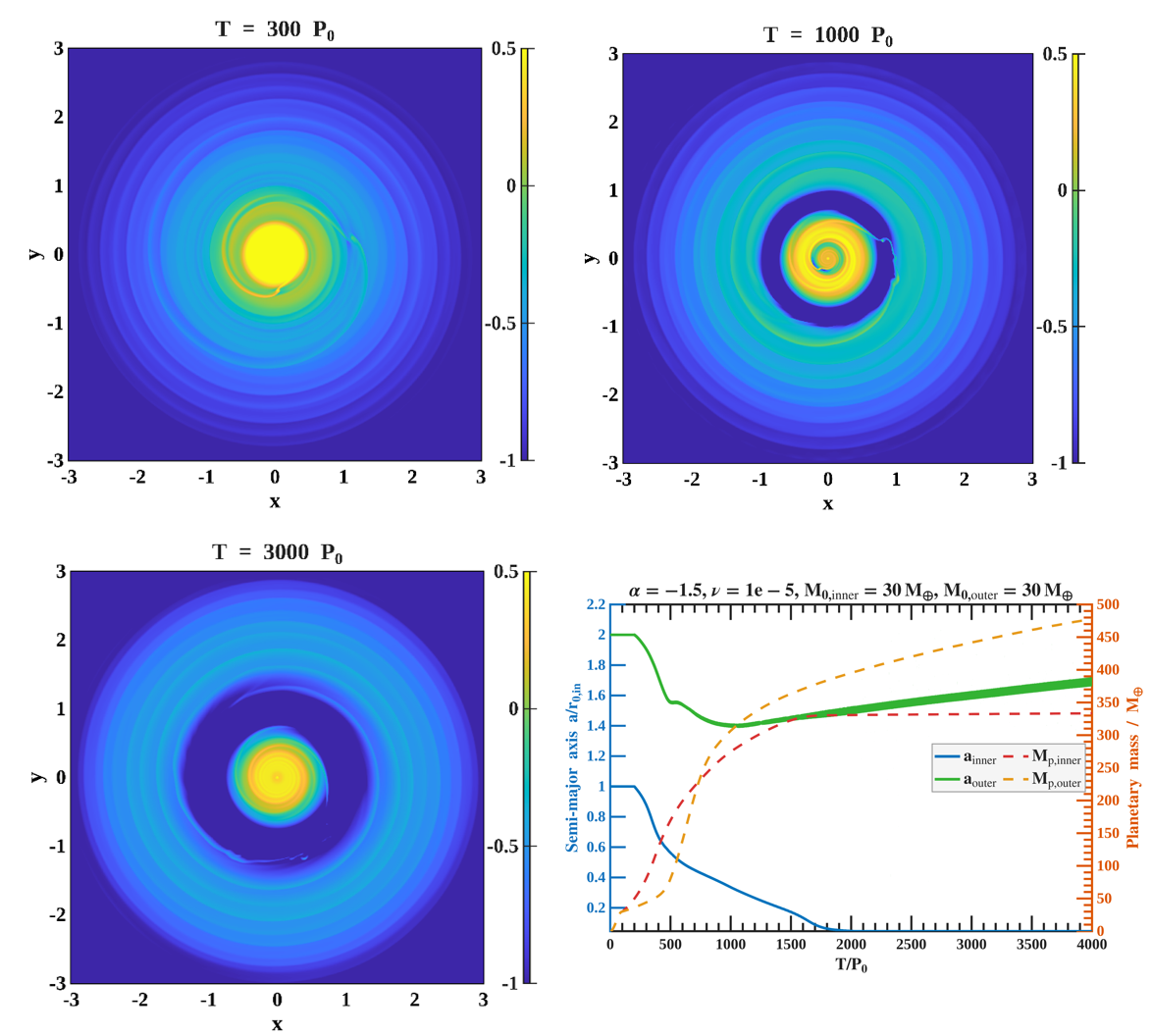
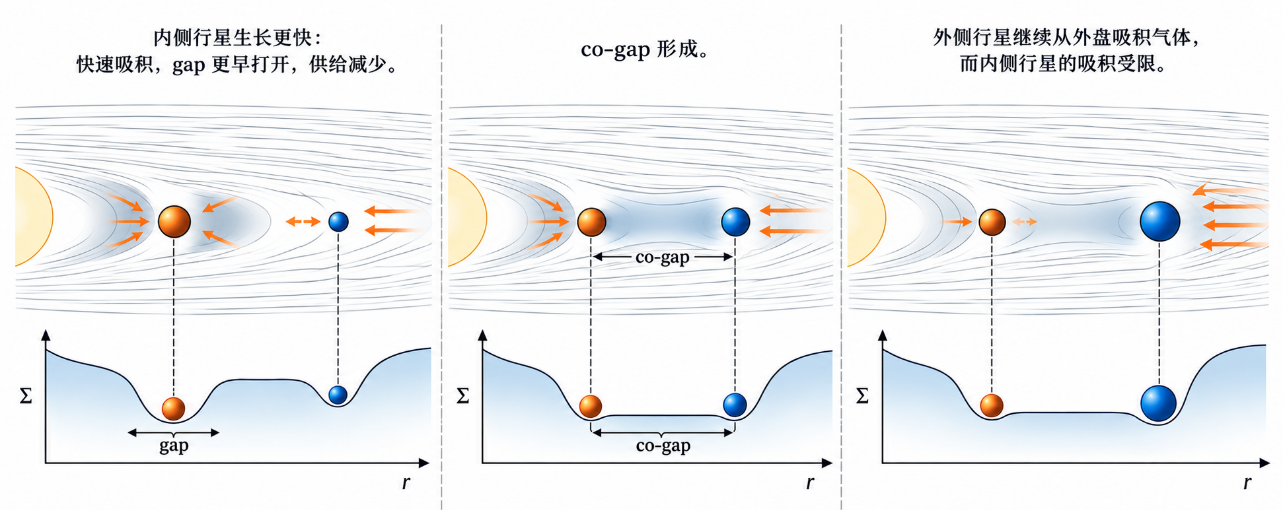
Figure 1 Formation of a common gap and the associated evolution of planetary masses and orbits in the simulations.
When Orbital Migration Meets Gas Accretion
The simulations also show that orbital migration does not necessarily proceed continuously inward. Rapid gas accretion can modify the local gas structure and gravitational torques, producing temporary outward migration in some cases. Inward migration may subsequently resume as the gaps deepen. Different initial planetary mass configurations and disk parameters can lead to convergent or divergent migration, influencing whether the planets approach one another and become trapped in mean-motion resonances. Disk viscosity, surface density slope, and the initial core-mass ratio all affect the final mass ratio and orbital architecture.
New Insights into the Formation of Giant Planet Systems
This study brings orbital migration, resonance capture, common-gap formation, and competitive gas accretion together within a unified evolutionary framework. It provides a possible formation pathway for explaining some compact giant planet pairs with comparable masses or more massive outer companions. An important implication is that the planetary mass ratios observed today may not preserve the original mass ordering of their planetary cores. Instead, the mass hierarchy may have been reshaped during the protoplanetary disk phase.
The study also has well-defined limitations. The simulations adopt two-dimensional, locally isothermal disk models and a parameterized treatment of gas accretion. Moreover, gas remains in the disk at the end of the simulations, and the long-term dynamical stability of the systems after disk dispersal has not yet been investigated. Therefore, the proposed mechanism offers a physically plausible explanation for the observed planetary architectures rather than a unique determination of the formation history of any individual system.
Paper Link: https://iopscience.iop.org/article/10.3847/1538-4357/aeb2df
Scientific Contacts:
Bixuan Zhao: zhaobixuan@shao.ac.cn
Hui Zhang: zhangh@shao.ac.cn


