

Research News
Shanghai Astronomical Observatory Makes New Advances in CSST Astrometry Research
Recently, the astrometry team at the Shanghai Astronomical Observatory of the Chinese Academy of Sciences used large-scale simulated data to systematically evaluate the ability of the China Space-station Survey Telescope (CSST) and the European Space Agency’s Gaia satellite to jointly detect binary stars. The study found that combining epoch astrometry from both missions can effectively improve binary orbit determination, particularly for long-period binaries. The findings were published in Astronomy & Astrophysics.
Binary stars are important objects for studying stellar formation and evolution, measuring stellar masses, and searching for compact objects such as black holes and neutron stars. In a binary system, a star moves around the barycenter under the gravitational influence of its companion, producing tiny wobbles in its position on the sky. High-precision astrometric observations can detect this orbital motion and thereby determine the orbital parameters of the binary, providing an important basis for measuring the mass of the companion. However, for binaries with long orbital periods, observations from a single survey mission often cover only part of the orbit, making it difficult to determine the orbital parameters accurately.
To evaluate CSST’s ability to detect binaries, the astrometry team at the Shanghai Astronomical Observatory constructed a large simulated sample and performed simulated observations and astrometric solution. The team used information including single-star solutions, proper-motion anomalies, and the distribution of observation times, together with machine learning, to select binary candidates. They then fitted orbits for the candidates and compared the results from Gaia, CSST, and joint observations.
In the test sample, 80.2% of the binary candidates selected by the team were binaries in the simulated sample. The team then performed orbital fitting for the candidates under different observing scenarios. Among the orbital solutions from joint fitting that passed the stringent quality-selection criteria, the fitted periods showed a tighter correspondence with the true periods (Figure 1). Among true binaries for which orbital fitting succeeded under each scenario, the fraction satisfying additional quality criteria increased from 6.76% for Gaia observations alone to 10.46% for joint observations. For long-period binaries with orbital periods exceeding 15 years, this fraction increased from 2.37% to 6.78%, approximately 2.9 times the original value (Figure 2). This advantage is mainly due to the longer observational time baseline obtained by combining the two missions.
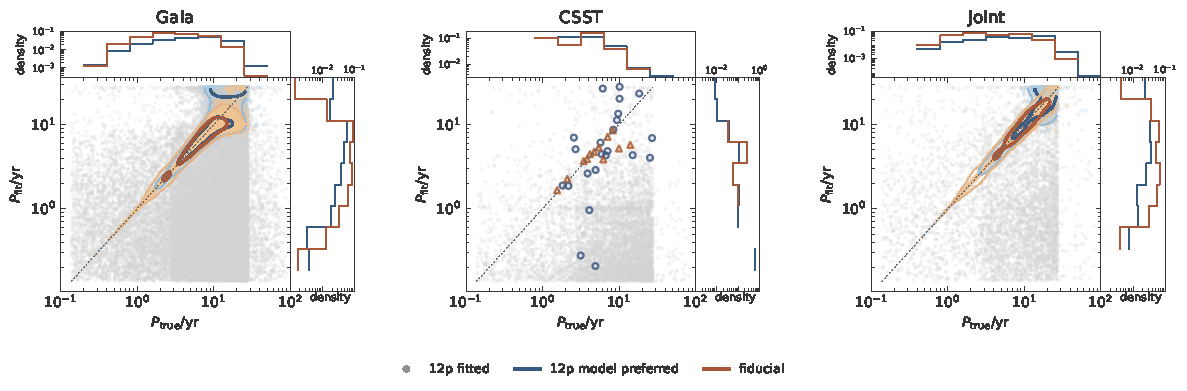
Figure 1. Comparison of the fitted orbital periods (vertical axis) and true orbital periods (horizontal axis) of simulated binaries using Gaia, CSST, and joint observations. The dashed line indicates equality between the two periods. Orange denotes orbital solutions that satisfy the selection criteria, blue denotes orbital solutions that satisfy only the model-comparison criterion, and gray denotes other orbital solutions.
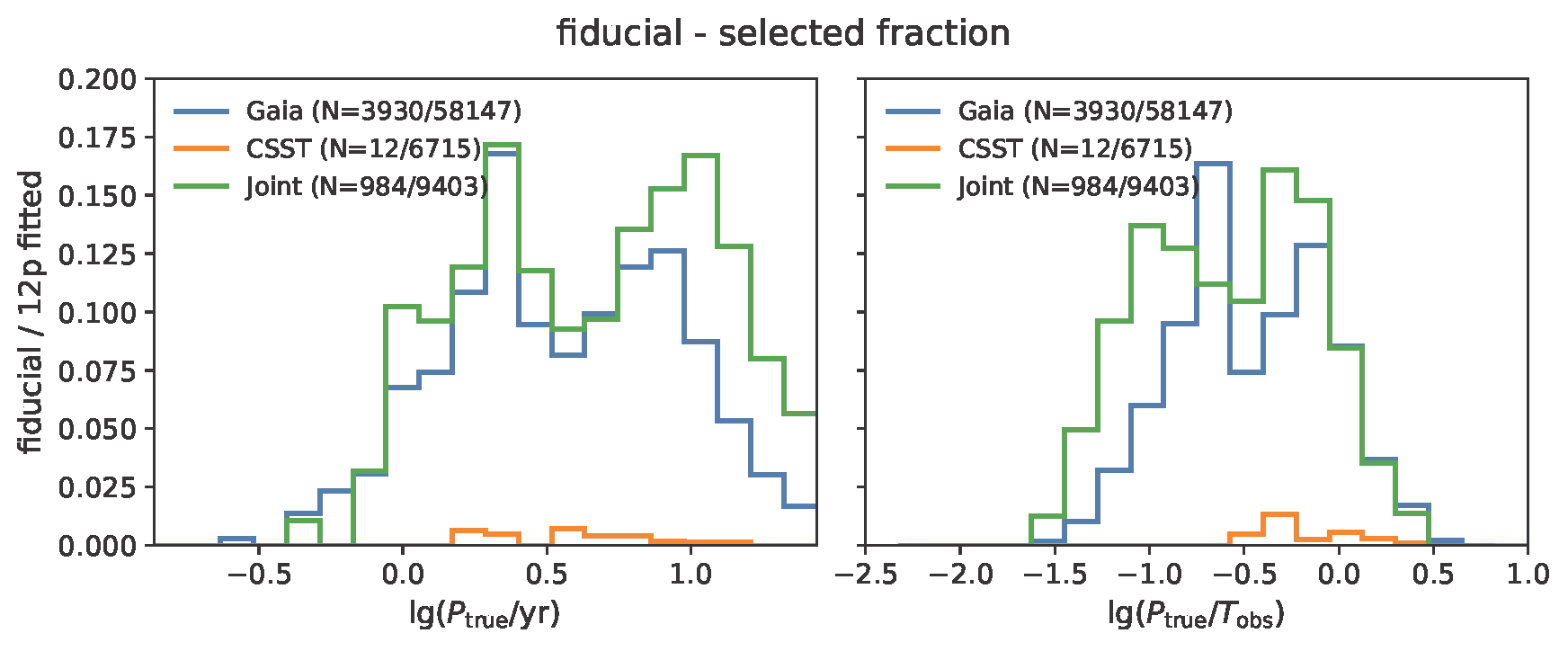
Figure 2. Fraction of successfully fitted simulated binaries satisfying the orbital-solution selection criteria in Gaia, CSST, and joint fits, as a function of the true orbital period (left) and the ratio of the orbital period to the observational time baseline (right). Green indicates joint observations, blue indicates Gaia, and orange indicates CSST.
The study also compared the current CSST survey schedule with three idealized, uniformly spaced observing schedules. The simulations showed that even with a similar number of observations, distributing the observations more evenly in time can increase the number of orbital solutions satisfying the quality criteria. This provides a reference for future follow-up observations of binary candidates.
Shangyu Wen, a PhD student at the Shanghai Astronomical Observatory and the first author of the paper, explained, “We simulated the astrometric time-series data of Gaia and CSST, first selecting targets that might have companions and then fitting binary orbits. We found that joint observations extend the time baseline and help determine the orbits of long-period binaries. A more uniform distribution of observation times also helps obtain reliable orbital solutions.”
Shilong Liao, a researcher at the Shanghai Astronomical Observatory and the corresponding author of the paper, said, “For long-period binaries, a sufficiently long observational time span is very important. Gaia and CSST conduct high-precision astrometric observations at different times and can therefore complement each other. With the future release of Gaia epoch astrometry and the accumulation of CSST observations, it is expected that more reliable orbital solutions for long-period binaries can be obtained, providing important data support for research on stellar evolution and compact objects.”
Based on the CSST survey schedule, the astrometry team at the Shanghai Astronomical Observatory carried out a simulation-based assessment of CSST’s astrometric capabilities, estimated the expected precision of stellar positions, proper motions, and parallaxes from ten years of simulated observations, and pointed out that optimizing the current survey schedule could effectively improve CSST’s astrometric performance. The team has now established a series of studies ranging from assessments of CSST’s single-star astrometric precision and improvements in star catalog accuracy through combination with Gaia, to scientific applications such as binary detection and orbit fitting, laying the foundation for the scientific use of future CSST observational data.
The Gaia satellite has already provided high-precision measurements of the positions, parallaxes, and proper motions of a large number of stars. CSST, which is about to begin observations, has a fainter detection limit and an expected operational lifetime of ten years, and is expected to extend high-precision astrometry to fainter stars. Previous collaborative research by Mario Gai of Astrophysical Observatory of Turin, Zhaoxiang Qi of the Shanghai Astronomical Observatory, and their colleagues showed that combining CSST observations with the Gaia star catalog could reduce the average error in stellar proper-motion measurements by a factor of approximately 3.6 and effectively slow the decline in catalog positional accuracy over time.
The other authors of the paper include Zhaoxiang Qi, Zhensen Fu, Xiyan Peng, Ye Ding, Qiqi Wu, Qi Xu, Xun Sun, Keyu Zhu, and Yong Yu. This work was supported by the National Key Research and Development Program of China, the National Natural Science Foundation of China, the Youth Innovation Promotion Association of the Chinese Academy of Sciences, the Natural Science Foundation of Shanghai, the Space Science Research Program of the China Manned Space Project, and the Talent Program of the Shanghai Branch of the Chinese Academy of Sciences.
DOI: https://doi.org/10.1051/0004-6361/202558478
Related research:
Gai et al. (2022), Consolidation of the Gaia catalogue with Chinese Space Station Telescope astrometry. https://doi.org/10.3389/fspas.2022.1002876
Fu et al. (2023), Simulation of CSST’s astrometric capability. https://doi.org/10.3389/fspas.2023.1146603
Scientific contacts
Shangyu Wen: shangyuwen@shao.ac.cn
Shilong Liao: shilongliao@shao.ac.cn


