

Facilities
Changbai Mountain 40m Radio Telescope
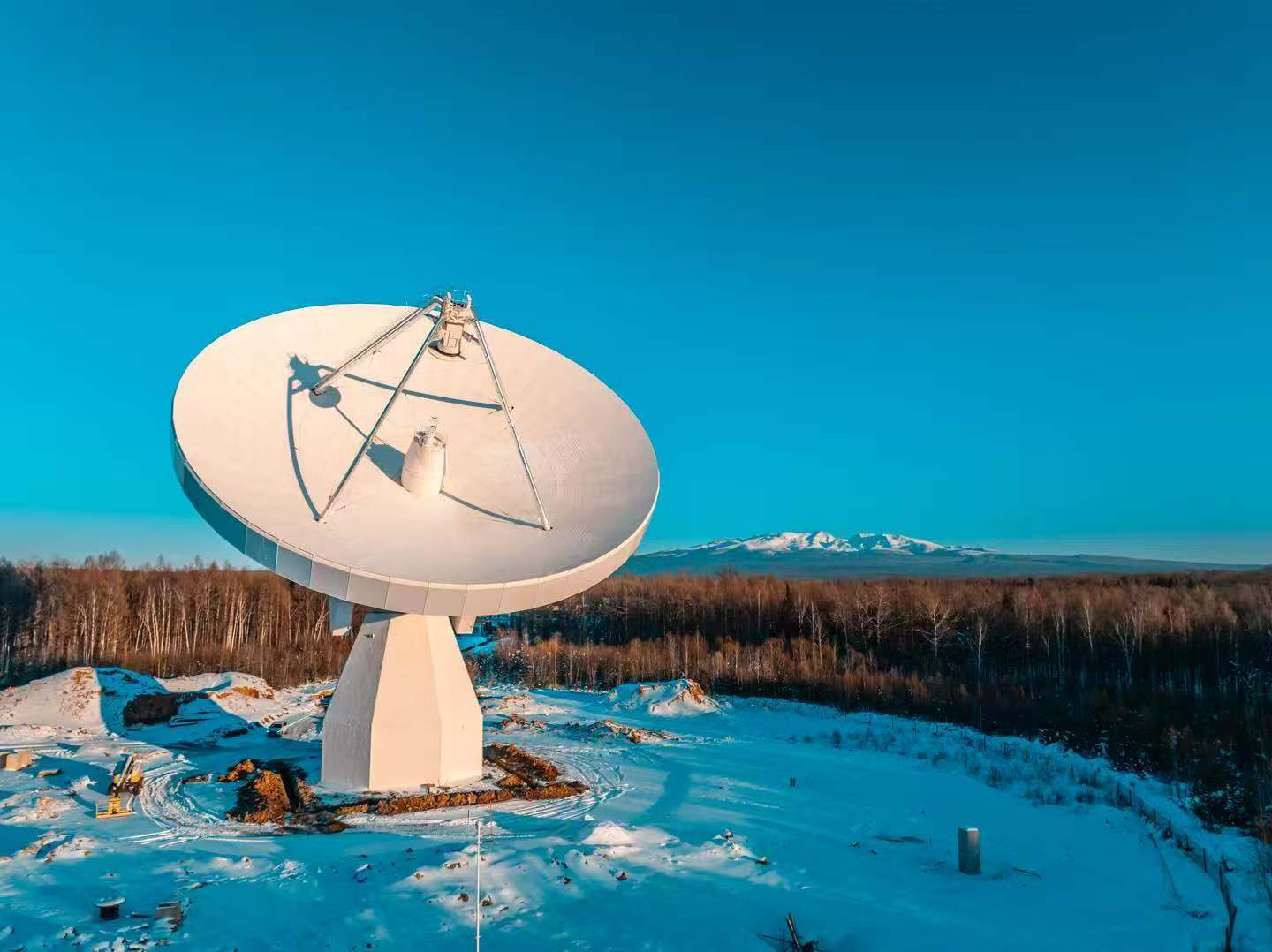
The Changbai Mountain Telescope is a general-purpose fully steerable 40-m diameter radio telescope designed to operate with high efficiency across the 0.7 – 50 GHz frequency range. The CMT is designed to be used for astronomy, geodesy and space science, both as a single dish and as part of Chinese and International VLBI (Very Large Baseline Interferometry) networks. The CMT operates as the first field observation facility of Shanghai Astronomical Observatory, Chinese Academy of Sciences. The telescope is located on the western slope of Changbai Mountain (Lat. 42°7’2’’ N – Long. 127°46’34’’ E), in southeastern border of Jilin province, China, at ≈1000 m elevation above sea level. Its official inauguration took place in December 2024. Following a six-month VLBI commissioning tests carried out in 2025, the CMT has joined launch phase of Tianwen-2 Asteroid Exploration Mission as a standard VLBI station successfully.
The telescope optical design is based on a standard Cassegrain configuration with 40-m diameter primary and 3.5-m diameter secondary reflectors. The turret at Cassegrain focus is designed to host up to 5 high frequency receivers. One distinctive design is the capability to use the primary focus for low frequency or PAF receivers by rotating the secondary reflector 90 degrees with focal length to diameter ratio f/D equal to 0.375. The primary reflector utilizes 468 aluminum panels and was aligned to a surface accuracy of 300 μm RMS.
Currently only S/X dual frequency band receiver with VLBI signal chain is operating. The main performances are underneath:
Frequency range: 2.15 – 2.45 GHz @ S-band, 8.2 – 9 GHz @ X-band;
Sensitivity: SEFD < 100 Jy @ X-band above 30 degrees elevation mostly;
Slew rate: 1 degree/second azimuth, 0.5 degree/second elevation;
Pointing accuracy: 10 arcsecond;
The Radio Quite Zone (RQZ) with a radius 3 kilometers protection zone and a radius 3 – 7 kilometers coordination zone was established by the local government in August 2025.


