

Highlights
Shanghai Astronomical Observatory’s SKA Radio Cosmology Team Achieves Wide-Field Direction-Dependent Calibration for 21CMA, Nearly Doubling the Number of Catalogued Radio Sources
Recently, the SKA Radio Cosmology Team at the Shanghai Astronomical Observatory (SHAO) of the Chinese Academy of Sciences (CAS), in collaboration with researchers from the National Astronomical Observatories of CAS (NAOC), has made significant progress in wide-field direction-dependent calibration and imaging with China's 21 Centimeter Array (21CMA), a radio telescope designed to probe the cosmic dawn. Direction-dependent calibration is a key technique for correcting direction-dependent errors in low-frequency radio observations and achieving high-fidelity wide-field imaging. The research team independently developed a direction-dependent calibration and imaging pipeline, named 21CMAcali, and successfully applied it to a region approximately 10 degrees in diameter around the North Celestial Pole. This approach effectively suppressed imaging artefacts around bright radio sources, improved the image dynamic range and enhanced the detection of faint radio sources. The team also constructed a new catalogue of 1,246 extragalactic radio point sources in the North Celestial Pole region, designated 21CMA-DDR1, containing nearly twice as many sources as the previous 21CMA catalogue released in 2016.
These results provide important technical support for future efforts to detect the 21-cm signal from the Epoch of Reionization (EoR). The study was published online in Monthly Notices of the Royal Astronomical Society (MNRAS). Qizhe Tang, a PhD student at SHAO, is the first author of the paper, and Associate Research Professor Jingying Wang is the corresponding author.
The 21-cm emission from neutral hydrogen during the Epoch of Reionization is redshifted into the low-frequency radio band by the expansion of the Universe, providing an important probe of the formation of the first stars and galaxies. However, this faint signal is overwhelmed by astrophysical foreground emission that is approximately four to five orders of magnitude brighter. Accurate calibration of observational data and characterisation of foreground radio sources are therefore essential for detecting the faint cosmological signal amid the much brighter foreground emission.
As low-frequency pathfinders and precursors to the Square Kilometre Array (SKA), the Low Frequency Array (LOFAR), the Murchison Widefield Array (MWA) and the 21 Centimeter Array (21CMA) have accumulated extensive observational datasets, providing valuable support for the scientific research and technological development of the SKA-Low telescope. LOFAR has implemented direction-dependent calibration and imaging pipelines based on killMS and DDFacet in large-scale surveys such as the LOFAR Two-metre Sky Survey (LoTSS), while also developing a range of calibration approaches tailored to different scientific objectives. The MWA has also explored direction-dependent calibration techniques, including the Low-frequency Excision of Atmosphere in Parallel (LEAP) method. Developing high-fidelity calibration and imaging pipelines tailored to the observing strategies and instrumental responses of individual arrays is essential for fully exploiting the scientific potential of these datasets.
In low-frequency radio observations, both ionospheric disturbances and the telescope response vary with direction across the sky. Traditional direction-independent calibration typically applies a single set of calibration solutions across the entire field of view, making it difficult to fully correct for these effects. Direction-dependent calibration addresses this limitation by solving for separate calibration solutions in different regions of the sky, thereby correcting direction-dependent errors. For 21CMA, strong grating-lobe responses associated with bright sources in the field of view, together with residual imaging artefacts, have long limited imaging quality and can obscure nearby faint radio sources, making direction-dependent calibration particularly important.
In this study, the research team used 24 hours of continuous observations obtained with 21CMA on 25 March 2013 to perform direction-dependent calibration and imaging across five sub-bands spanning 75–175 MHz. The observations covered a region centred on the North Celestial Pole, with a radius of 5 degrees and an area of approximately 78 square degrees.
The team integrated the DDFacet imaging software and the killMS calibration solver into the 21CMAcali pipeline, using 10 bright reference sources within the field of view to define the main calibration regions. They solved for direction-dependent gains that vary with time and frequency and jointly applied these calibration solutions during imaging of the entire field. In addition, an electromagnetic simulation-based model of the 21CMA primary beam was consistently incorporated into both calibration and imaging to account for variations in telescope sensitivity across the sky (Fig. 1). By combining direction-dependent calibration with wide-field imaging, this pipeline provides a technical foundation for suppressing imaging artefacts around bright sources and recovering faint radio sources.
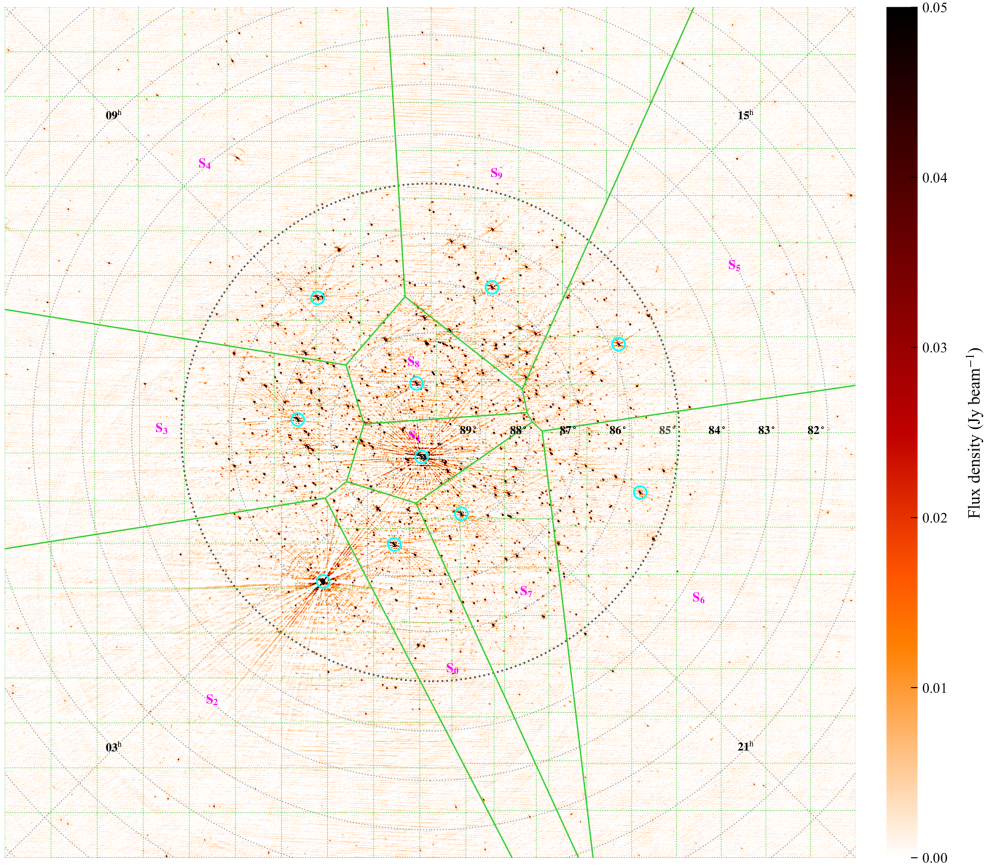
Figure 1. Schematic illustration of the field-of-view partitioning for 21CMA direction-dependent calibration. The background shows the sky image after direction-independent calibration in the 150–162.5 MHz band. Cyan circles mark the 10 bright reference sources, while thick green lines indicate the boundaries of the main calibration regions. (Figure 4 in the original paper)
The advantages of direction-dependent calibration were directly demonstrated through a comparison using the same observational dataset. Under identical data selection and imaging settings, direction-dependent calibration improved the image dynamic range by a factor of 1.19–2.03 across the five sub-bands compared with direction-independent calibration. Radial streaks and various sidelobe artefacts around the bright radio source 3C 61.1 were substantially reduced, making previously obscured faint sources easier to identify (Fig. 2). These improvements demonstrate that more accurate correction of direction-dependent errors can further unlock the imaging potential of existing 21CMA observational data.
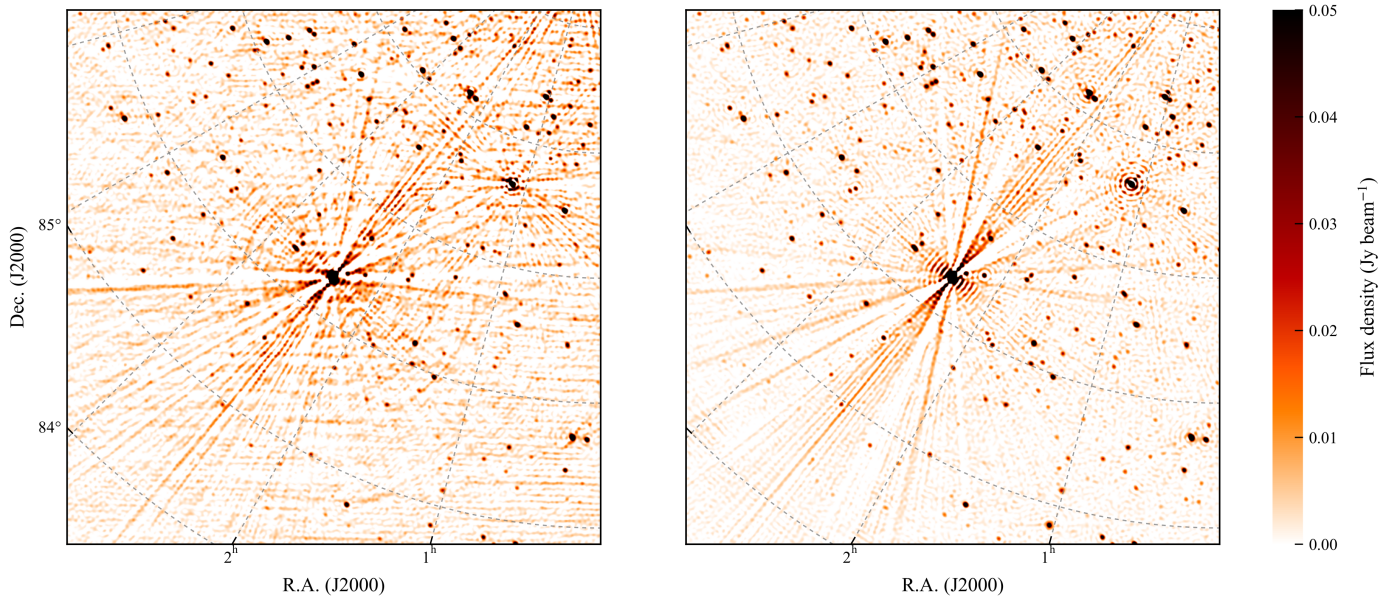
Figure 2. Comparison of images around 3C 61.1 in the 150–162.5 MHz band. The left and right panels show the results of direction-independent and direction-dependent calibration, respectively. The same data selection, imaging parameters and colour scale were used for both images, and no primary beam correction was applied. (Figure 5 in the original paper)
The suppression of imaging artefacts further improved point-source extraction. By combining automated source extraction, cross-band validation and morphological filtering, the team constructed 21CMA-DDR1, the first 21CMA point-source catalogue based on direction-dependent calibration. The catalogue contains 1,246 extragalactic radio point sources, providing information on their positions, flux densities across multiple frequency bands and spectral indices. The number of catalogued sources is nearly twice that of the first 21CMA catalogue released in 2016, demonstrating the advantages of direction-dependent calibration and the associated data processing pipeline in recovering faint radio sources (Fig. 3).
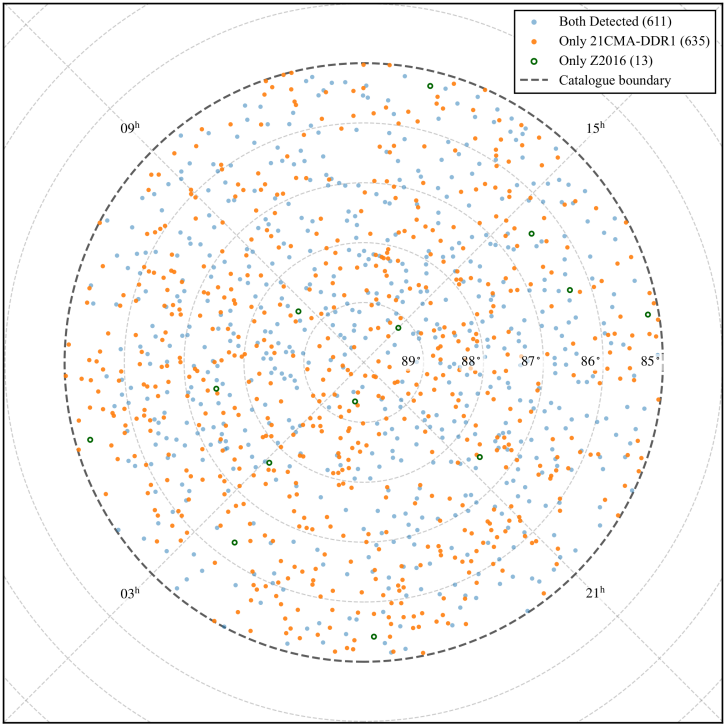
Figure 3. Comparison of the source distributions in the old and new 21CMA catalogues. Blue dots represent the 611 sources common to both catalogues, orange dots indicate the 635 sources found only in 21CMA-DDR1, and dark green open circles mark the 13 sources found only in the 2016 catalogue. (Figure 11 in the original paper)
In terms of scientific applications, the team used a dedicated wideband sky image centred at 150 MHz to perform a source-count analysis of 580 point sources within a radius of 3 degrees around the North Celestial Pole. At relatively high flux densities, the overall trend of the Euclidean-normalised differential source counts was broadly consistent with results from LOFAR and MWA surveys, as well as predictions from the SKADS and T-RECS radio sky models. These findings provide observational evidence for assessing the statistical properties of foreground radio sources in this region of the sky (Fig. 4).
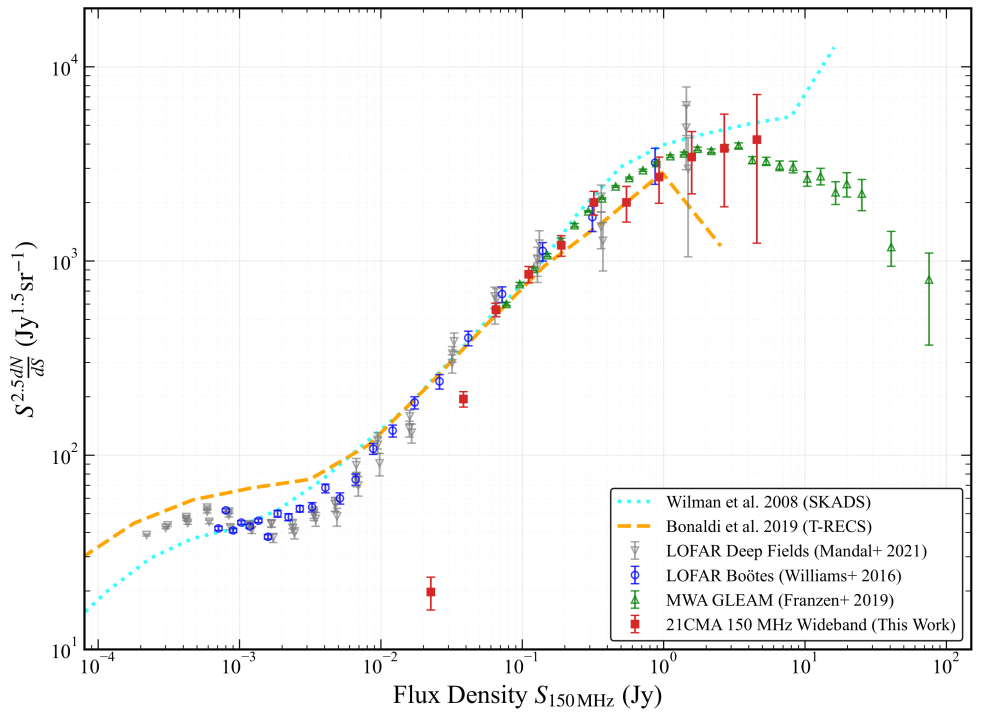
Figure 4. Euclidean-normalised differential source counts from 21CMA at 150 MHz. Red squares represent the results of this study, while the other data points and curves show results from previous surveys and radio sky models, allowing a comparison of the source count distributions across different flux density ranges. (Figure 19 in the original paper)
This study has successfully demonstrated wide-field direction-dependent calibration for 21CMA, significantly improving image fidelity and the recovery of faint radio sources. These achievements establish an important technical foundation for fully exploiting the scientific potential of 21CMA's extensive archival observations. The direction-dependent calibration and imaging pipeline developed in this study also offers valuable insights into foreground modelling and systematic error mitigation in low-frequency radio observations. Looking ahead, the team plans to further refine its direction-dependent calibration strategies, advance the joint processing of observations from multiple days, and conduct 21-cm power spectrum analyses targeting the Epoch of Reionization. The team also aims to promote the application of these techniques to SKA-Low, providing technical support for future studies of the Epoch of Reionization with the next generation of low-frequency radio telescopes.
This work was supported by the National SKA Program of China, funded by the Ministry of Science and Technology of China, and the National Natural Science Foundation of China (NSFC).
DOI: https://doi.org/10.1093/mnras/stag2080
Pipeline: https://github.com/astroJyWang/21CMAcali
Scientific contacts:
Qizhe Tang: qztang@shao.ac.cn
Jingying Wang: jywang@shao.ac.cn


