

About
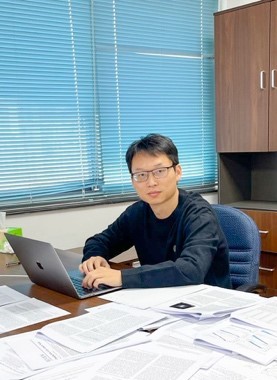
Hengxiao Guo is a Research Professor at the Shanghai Astronomical Observatory, Chinese Academy of Sciences (SHAO), and serves as Deputy Head of the AGN Structure and Evolution Group. He received his B.Sc. in Applied Physics from Yunnan University in 2010 and his Ph.D. in Astrophysics from SHAO in 2016. From 2015 to 2022, he conducted joint doctoral and postdoctoral research at the University of California, Los Angeles; the University of Science and Technology of China; the University of Illinois Urbana-Champaign; and the University of California, Irvine. He joined SHAO in 2022.
His research focuses on active galactic nuclei and black hole astrophysics, particularly multiwavelength time-domain studies of black holes. His work encompasses the search for and confirmation of intermediate-mass black holes, AGN variability and reverberation mapping, and multiwavelength observations of tidal disruption events. He initiated and leads the international Intermediate-Mass Black Hole Reverberation Mapping Project (IMBH-RM Project), coordinating multiwavelength observations across space- and ground-based facilities. As principal investigator, he has led teams awarded more than 800 hours of observing time with major space observatories, including JWST, HST, Chandra, XMM-Newton, Swift, and the Einstein Probe (EP), as well as leading ground-based facilities such as Subaru, VLT, Gemini, GTC, HSA, VLBA, and EVN. As of August 2026, he has published more than 80 research papers.
Research Areas
Multiwavelength time-domain studies of black holes, including reverberation mapping, intermediate-mass black holes, supermassive black hole binaries, tidal disruption events, and changing-look active galactic nuclei.
Selected Publication
Public codes:
1. Hengxiao Guo, Yue Shen, & Shu Wang, 2018, PyQSOFit: Python code to fit the spectrum of quasars, Astrophysics SourceCode Library, record ascl:1809.008. (https://github.com/legolason/PyQSOFit)
Publication:
2. Yu Pan, Hengxiao Guo*. 2026, “The Intermediate-Mass Black Hole Reverberation Mapping Project: Stable Optical Continuum Lags of an Intermediate-Mass Black Hole in the Dwarf Galaxy NGC 4395 over Years”, ApJ, 1003, 196.
3. Hengxiao Guo, et al. 2026, “Evidence for a Delayed Ultraviolet Counterpart to X-Ray Quasiperiodic Eruptions in Ansky”, ApJL, 1000, L57.
4. Jingbo Sun*, Hengxiao Guo*. 2025, “The Intermediate-Mass Black Hole Reverberation Mapping Project: First Detection of Mid-infrared Lags in Prototypical Intermediate-Mass Black Holes in NGC 4395 and POX 52”, ApJL, 989, L26.
5. Qi Yuan*, Hengxiao Guo*. 2025, “First Detection of Radio Emission from the Intermediate-Mass Black Hole in POX 52: Deep Multiband Observations with ATCA and VLA”, ApJ, 980, 97.
6. Hengxiao Guo, et al. 2025, “Reverberation Evidence for Stream Collision and Delayed Disk Formation in Tidal Disruption Events”, ApJ, 979, 235.
7. Wenke Ren*, Hengxiao Guo*. 2024, “Prior-informed Active Galactic Nucleus Host Spectral Decomposition Using PyQSOFit”, ApJ, 974, 153.
8. Wenwen Zuo*, Hengxiao Guo*. 2024, “Optical Continuum Reverberation Mapping of a Candidate IMBH in a Nearby Seyfert 1 Galaxy”, ApJ, 974, 288.
9. Shu Wang*, Hengxiao Guo*. 2023, “Estimating AGN Black Hole Masses via Continuum Reverberation Mapping in the Era of LSST”, ApJL, 948, L23.
10. Hengxiao Guo, et al. 2022, “Active Galactic Nuclei Continuum Reverberation Mapping Based on Zwicky Transient Facility Light Curves”, ApJ, 940, 20.
11. John W. Montano*, Hengxiao Guo. 2022, “Optical Continuum Reverberation in the Dwarf Seyfert Nucleus of NGC 4395”, ApJL, 934, L37.
12. Hengxiao Guo, et al. 2022, “The Paschen Jump as a Diagnostic of the Diffuse Nebular Continuum Emission in Active Galactic Nuclei”, ApJ, 927, 60.
13. Hengxiao Guo, et al. 2020, “High-redshift Extreme Variability Quasars from Sloan Digital Sky Survey Multiepoch Spectroscopy”, ApJ, 905, 52.
14. Hengxiao Guo, et al. 2020, “Dark Energy Survey Identification of a Low-mass Active Galactic Nucleus at Redshift 0.823 from Optical Variability”, MNRAS, 496, 3636.
15. Hengxiao Guo, et al. 2020, “Spectral Energy Distributions of Candidate Periodically Variable Quasars: Testing the Binary Black Hole Hypothesis”, MNRAS, 492, 2910.
16. Hengxiao Guo, et al. 2020, “Understanding Broad Mg II Variability in Quasars with Photoionization: Implications for Reverberation Mapping and Changing-look Quasars”, ApJ, 888, 58.
17. Hengxiao Guo, et al. 2019, “Discovery of an Mg II Changing-look AGN and Its Implications for a Unification Sequence of Changing-look AGNs”, ApJL, 883, L44.
18. Hengxiao Guo, et al. 2019, “Constraining Sub-parsec Binary Supermassive Black Holes in Quasars with Multi-epoch Spectroscopy—III. Candidates from Continued Radial Velocity Tests”, MNRAS, 482, 3288.
19. Hengxiao Guo, et al. 2017, “How Far Is Quasar UV/Optical Variability from a Damped Random Walk at Low Frequency?”, ApJ, 847, 132.
20. Hengxiao Guo, et al. 2016, “The Optical Variability of SDSS Quasars from Multi-epoch Spectroscopy. III. A Sudden UV Cutoff in Quasar SDSS J2317+0005”, ApJ, 826, 186.
21. Hengxiao Guo, et al. 2016, “The Optical Variability of SDSS Quasars from Multi-epoch Spectroscopy. II. Color Variation”, ApJ, 822, 26.
22. Hengxiao Guo, et al. 2014, “The Optical Variability of SDSS Quasars from Multi-epoch Spectroscopy. I. Results from 60 Quasars with ≥ Six-epoch Spectra”, ApJ, 792, 33.
See details: https://ui.adsabs.harvard.edu/user/libraries/EWEXQiTiQvKQS2Hs0O6x4w


